How to optimize for People Also Ask? Complete 2026 guide

Search engine optimization has long revolved around keywords, backlinks, and content quality. Yet in recent years, one of the most dynamic shifts in how Google structures results is the introduction and expansion of the “People Also Ask” (PAA) box. These expandable questions are more than a curiosity for users; they are a major opportunity for publishers. Understanding how to optimize for People Also Ask is now a central part of SEO strategy, especially for brands that want to boost visibility and authority without necessarily ranking first for every keyword.
Why People Also Ask matters in modern search?
The PAA box is Google’s way of addressing intent beyond the initial query. A user searching for “best project management tools” may trigger a set of related questions like “What is the easiest project management tool?” or “Is Trello free?” Each of these questions, when expanded, reveals a concise answer snippet sourced directly from a webpage. For publishers, this means that winning a PAA spot can put their content directly in front of users, often above organic results.
From a visibility perspective, PAA functions like a fast track to brand recognition. Even if your site does not appear in the top three traditional results, being featured in an answer can drive significant traffic and signal authority. Moreover, because PAA questions often reflect long-tail search behavior, they capture audiences with a clear interest in learning, comparing, or purchasing.
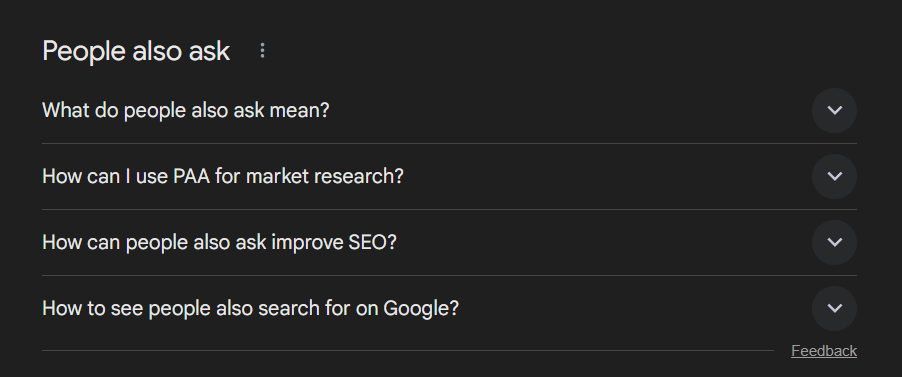
Understanding how Google selects PAA content
Google’s algorithm uses a mixture of semantic analysis, user behavior data, and content relevance to populate the PAA box. Unlike traditional snippets, where the structure of the page is paramount, PAA seems to favor clear, direct answers to specific questions.
The common thread across PAA winners is content that mimics the natural way people ask questions. This means headings framed as questions, sentences that provide definitions or explanations in under 50 words, and content structured so that Google can easily extract a self-contained answer. Equally important is the breadth of coverage. Pages that address multiple related queries are often more successful because they align with the branching nature of user intent.
Strategies for capturing PAA opportunities
Optimizing for People Also Ask requires precision and a nuanced approach. While many general SEO tactics still apply, the focus should be on aligning with how real people phrase their questions and how Google rewards concise, authoritative answers. Key strategies include:
- Identify questions users are asking by researching search queries with tools like SEMrush, Ahrefs, or even Google’s own autocomplete suggestions.
- Create content that directly addresses those questions, preferably with a headline phrased as the query itself.
- Provide succinct answers in the first sentence, followed by deeper detail for those who want to explore further.
- Use structured data markup where possible to help Google understand the content hierarchy.
- Update older content regularly, as PAA boxes often refresh with newer sources.
| Factor | Why it matters | Best practice |
| Question-based headings | Google often looks for queries that match user intent | Use H2/H3 formatted as natural questions |
| Concise answers | PAA snippets prioritize short, direct responses | Provide 40–60 word summaries before expanding |
| Content depth | Authority matters for snippet selection | Cover topics comprehensively, not just superficially |
| Structured data | Helps Google interpret hierarchy and relevance | Apply FAQ schema or Q\&A markup where appropriate |
| Regular updates | PAA results refresh based on trends | Audit and update content every 6–12 months |
By integrating these steps, publishers can improve the likelihood of being featured in PAA and benefit from the additional exposure.

Common mistakes to avoid
Many brands fall into traps when attempting to optimize for People Also Ask. One of the most frequent errors is overstuffing content with questions in a way that feels unnatural. While including questions is valuable, user experience must remain central. Another misstep is failing to provide a clear, direct answer before elaborating. Google’s crawler prioritizes text that can be extracted into a standalone sentence or two.
Additionally, some publishers neglect the ongoing nature of PAA optimization. Because the box dynamically updates based on trends and user interactions, content that was featured six months ago may no longer appear. Continuous monitoring and adaptation are essential to remain visible.
The role of content depth and authority
While brevity is crucial for PAA snippets, depth still matters. Google prefers sourcing answers from sites it deems authoritative, which means thin content is unlikely to succeed. Articles that provide comprehensive coverage of a topic stand a better chance of being chosen, as they indicate expertise and reliability. For example, a blog post on “how to optimize for people also ask” that not only answers the direct question but also explains the mechanics of PAA, common mistakes, and broader SEO implications will signal more value than a short post that simply scratches the surface.
Equally, authority can be built through backlinks, user engagement metrics, and the overall domain reputation. Optimizing for PAA is not just about formatting – it is about creating genuinely useful resources that the algorithm recognizes as trustworthy.
Bringing it all together
The People Also Ask box is not a side note in the evolution of search – it is a central feature that reflects Google’s move toward intent-driven discovery. Brands that want to remain competitive need to consider PAA not as an optional bonus but as a strategic priority. Success lies in producing content that directly answers user questions, balancing clarity with depth, and maintaining a cycle of optimization and updates.
For businesses that lack the resources or expertise to navigate these complexities, working with a dedicated SEO partner can make all the difference. Agencies like createIT specialize in crafting strategies that align with search engine behavior while keeping user experience at the forefront. From keyword research to technical optimization and content development, createIT helps brands capture opportunities like PAA and convert visibility into measurable growth.















![How to Fight AI Hallucinations About Your Brand [ready-to-use prompt inside]](https://www.createit.com/wp-content/uploads/2026/02/How-to-Fight-AI-Hallucinations-355x200.jpg)